Growth & CRO
The cheapest e-commerce CRO: ship one fix a week
· Updated · 5 min read
S
Get CRO Checklist — 17 fixes
The 17-point checklist from the 73%→54% teardown. Same format, new numbers.
No spam, unsubscribe anytime. I only email teardowns.
Keep reading
The short answer
CRO on a D2C furniture brand wasn't a redesign — it was weekly micro-forensics with a metric attached to each decision. Fix the checkout surprise, fix the form field, fix the search weights, and measure each. One measured fix a week compounds faster and with less risk than one big-bang redesign a quarter.
Everyone on the team wanted the splashy redesign. Nobody wanted the 17 boring fixes. The splashy redesign was a bet on taste; the boring fixes were a bet on measurement — and measurement is the only thing that pays out predictably. Baymard's research puts average cart abandonment near 70% — which means every store is sitting on a backlog of small, findable leaks that no single redesign will ever name.
What "one fix a week" meant at Sierra
We flattened CRO into a repeatable pipeline, four steps, no heroics involved:
- Pick a funnel step — checkout, form, search, or product page.
- Form a short hypothesis from events + sessions, in one sentence.
- Ship the cheapest change that tests it — not the most impressive one.
- Watch one KPI for two weeks. Keep it, kill it, or learn from it. No orphan changes.
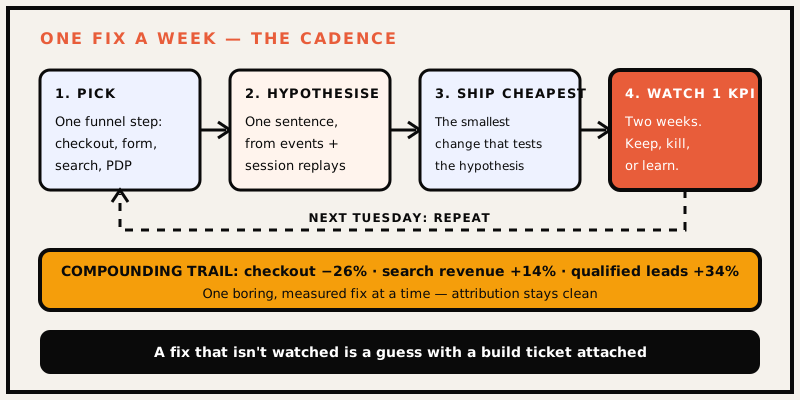
The whole discipline is step 4. A fix that isn't watched is a guess with a build ticket attached.
A sample of fixes that shipped
- Shipping on the cart page. Surprise shipping cost was killing checkout; the display fix alone moved the abandonment needle.
- Search synonyms re-weighting. Not flashy, but search-attributed revenue lifted +14% — one of the store's quietest, highest-ROI wins.
- Form field objection microcopy. One uncommunicated field was costing the team the form fix; a label, not a field deletion, turned it around.
The cadence vs the splash
| One fix a week | The big redesign | |
|---|---|---|
| Learning per change | high | low |
| Ramp | smooth, reversible | risky, all-or-nothing |
| Attribution | the change owns the delta | noise |
| Measurement | rigorous | loud but noisy |
The telling column is attribution. Redesigns can't tell you which thing worked. Weekly fixes can — because each one is small enough to name as the cause.
What I'd do differently
- Keep a central hypothesis log. If a thought sits unmeasured for a week, it's dead. A queue of micro-tests compounds like a good backlog.
- Attach every fix to one KPI. Vague fixes kill the funnel's red thread; a fix with an owner KPI survives review.
When not to use the weekly cadence
Being honest about the limits is part of the discipline. One-fix-a-week fails in four situations:
- The funnel is structurally broken. If your checkout errors on half of attempts regardless of UX, fixing the copy is grinding powder. Fix the architecture once, deeply.
- You don't have measurement. The cadence is the measurement. Without events, the weekly fix is a prayer. Instrument first or skip the routine.
- The win can't be isolated. Some changes entangle — new page + new template + new flow in one PR. The cadence requires one change per KPI. Resist combos.
- The team reuses "the splash always fails" as an excuse for slowness. A weekly fix that never ships is just a slow redesign with braver language. The cadence has to ship.
Knowing the four exit conditions is what separates a shop that does CRO from a shop that talks about it.
How to read the two-week window
A common question when teams adopt this: "what if the KPI hasn't moved after two weeks?" Three honest answers, in order of likelihood:
- The fix doesn't matter (most common). It moved nothing; kill it, log it, move on. Not every change needs to win.
- The KPI is too coarse. If the window can't show the delta, refine the KPI before re-running.
- You need a variant, not a removal. If the data hints the direction was right but the execution weak, run the next cheap variant — don't abandon the line.
The trap is leaving the window open forever. A fix that "might still pay off next month" is a fix that's never been measured. Close the loop on schedule; keep the learnings in the log.
The compounding math, plainly
Rough numbers, no spreadsheet glamour: one fix at a rough 1–5% lift per test — realistically optimistic — compounds into something a single redesign can't match. But you shouldn't believe me: the actual people reading this post have the checkout (−26%), the form (+124%), and the category (+34% qualified) as the evidence trail from a single disciplined year.
That's the whole pitch of the weekly cadence. It's unglamorous, and it pays predictably.
The mechanics behind those fixes are the connected stories: the category redesign, the form teardown, and the flagship checkout story — with the full numbers in the cart & checkout case study. Read them together — they're the same discipline at three different scales.
The one-fix cadence, run for real
Here's what a surrogate month of the routine looked like on a D2C store — not a master plan, just four Tuesdays:
- Week 1 fix: Shipping shown on cart page. Hypothesis: users bail at the shipping step because the total arrives late. KPI: checkout abandonment. Result: the needle moved; keep.
- Week 2 fix: Promo field validation. Hypothesis: rage-clicks came from a field that ate input without a reply. KPI: rage-clicks at the field. Result: cleaned up 68% of them; keep (already covered in the form post).
- Week 3 fix: Search synonym weights. Hypothesis: searchers didn't find "buffet" because weights skewed "cabinet." KPI: search-attributed revenue. Result: +14%, keep.
- Week 4 fix: Category page intent filter. Hypothesis: attribute filters ignore needs. KPI: qualified leads. Result: +34%, keep — covered in category.
That's the entire emotional experience of CRO at scale: boring change, boring measurement, boring win, repeated. The splash comes from compounding, not from any single Thursday.
Why the boring framing is a superpower
When you tell a stakeholder "we'll ship the smallest thing that could work," you're actually buying three things at once:
- Faster learning — a one-file change ships this week, not next quarter.
- Reversibility — if it fails, you remove it without a postmortem.
- Attribution — one change = one KPI, so when it moves you know why.
The redesign offers the thrill of scale and the torture of unblameable noise. The weekly fix offers none of the thrill and all of the accountability — which is why it compounds.
Frequently asked questions
What is conversion rate optimization in ecommerce?+
Improving the share of store visitors who complete a purchase or submit a lead. One measured fix a week compounds faster than a redesign.
How much traffic do you need for CRO?+
Enough for a directional weekly read — we used before/after cohorts on 15K+ weekly sessions, not paired A/B tests.
Why one fix instead of a big design?+
Rewrites rotate learnings little and concentrate risk. Three targeted steps beat one cathartic overhaul.