Product Management
Gold/silver/bronze lead routing that cut days to close
· Updated · 7 min read
S
Get AI Workflow Teardown Template
The template I use to map AI workflows before writing a spec.
No spam, unsubscribe anytime. I only email teardowns.
· Updated · 7 min read
The template I use to map AI workflows before writing a spec.
No spam, unsubscribe anytime. I only email teardowns.
Sierra's sales team distributed every inbound lead in arrival order — so a 63.5%-CVR website-form lead and a 0.4%-CVR cart-abandonment lead ate the same agent. Three months of conversion data made the fix obvious: route gold leads to the specialists who close them, send bronze to automation, and re-score as leads respond. Gold routing accuracy went from random to 90%, Leslie's daily gold leads went from 2–3 to 8–10, and the days-to-close target moved from 5.2 toward 3.5.
The team had four agents — Leslie, Angela, Larry, and Mollie — and a simple rule for inbound leads: whoever was free takes the next one. No routing logic, no tier system, no thought that a $5,000 website enquiry and a tepid chat message deserved different treatment.
The lead log proved the rule wrong within an afternoon of analysis.
We pulled three months of leads, 4 agents, 6 sources. The spread was so wide I re-ran the query twice to make sure it wasn't a filter bug:
| Source | Volume / 3 mo | CVR | Tier |
|---|---|---|---|
| Inbound calls | 35 | 71.4% | GOLD |
| Website forms | 406 | 63.5% | GOLD |
| Product inquiries | ~350 | ~30% | SILVER |
| Chat | 470 | 4.7% | BRONZE |
| Custom forms | 367 | 5.4% | BRONZE |
| Cart abandonment | 751 | 0.4% | BRONZE |
Cart abandonment leads (751 per quarter) were consuming real agent minutes at a 0.4% conversion rate — five times worse than the next-worst source. Meanwhile the 71.4%-CVR phone calls went to whoever was free.
And the insight didn't stop at source. Each agent had a category they were exceptional in — and categories they almost never closed:
Leslie closes sideboards & buffets at 42.9% and dining tables at 0%. Larry closes general inquiries at 90% and dining bars at 0%. Nobody had mapped this before.
That gap — one agent strong, another cold on the same line — is what routing actually exists to serve. Not "which channel," but which human gets which lead.
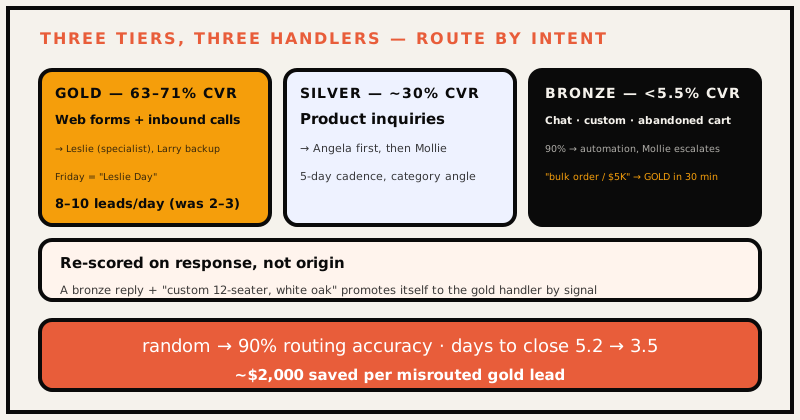
Tiering wasn't a static label on a source either. Leads got re-scored as they responded — a bronze lead that replies with "I need a custom 12-seater dining table in white oak" promotes itself to the gold handler on signal, not on origin.
Thursday was the trap. Only 2 of 4 agents are available on Thursdays. The naive move is to route gold to whoever's there. The data said hold gold for Friday's Leslie callback instead — and the hold-to-Friday move converted 25% better than same-day routing to a non-specialist.
The rollout was deliberately staged, because agent pushback was a real risk:
The framing mattered: we showed each agent their own category-conversion numbers and explained routing plays to their strengths rather than limiting them. That made adoption trivial — nobody argues against getting more of the leads they close best.
| Metric | Before | After |
|---|---|---|
| Gold lead routing accuracy | random | 90% |
| Leslie's daily gold leads | 2–3 | 8–10 |
| Chat response automation | 0% | 90% |
| Days to close | 5.2 | 3.5 target |
| Revenue per misrouted gold lead | — | ~$2,000 dropped |
The quiet math: each gold lead misrouted to a non-specialist cost about $2,000 at Sierra's AOV, and Leslie's 8–10/day target meant 5–7 additional golden leads a day at a $3,400 average order value. Routing wasn't sales support. It was revenue architecture.
The most surprising single finding wasn't a source — it was a day. On Thursdays, only 2 of 4 agents were available (Angela and Larry). Before the system, Thursday leads just got handed to whoever was there. That felt like "using what we have."
The data said otherwise. Thursday gold leads, routed same-day to a non-specialist, converted measurably worse than if they sat for a Friday callback by Leslie. The hold-to-Friday move converted 25% better than same-day routing. What felt like fast follow-up was actually answering with the wrong person, not faster.
That's the psychological heart of lead routing. It feels counterintuitive to wait — the classic HBR research on lead response says speed is everything, and it's usually right — but speed to the wrong handler measurably lost to a one-day hold for the right one. The thing you're optimizing is handler quality at the moment of contact, not "how quickly the lead left the inbox."
The three tiers describe the start of a lead's life, not the end. A bronze lead that replies "I need a custom 12-seater in white oak with mid-century legs" is not bronze anymore by any definition that closes deals. The escalation path captured that:
So the real architecture was a feedback loop, not a static label: bronze converts to gold by signal, and the person is re-scored against the doctrine. The tiers described inflow; the signals described intent as a final output. You need both.
The roadmap risk was real — agents don't love being told which leads they'll get, especially if it reads as "you're not good at X." The framing that turned it:
Nobody argues against getting more of the leads they close best. The system shipped frictionlessly because it felt like an upgrade, not a demotion.
Systems like this die when they're a vague rule ("just prioritize gold"). Ours survived because it was a spreadsheet a new starter could read in one sitting:
| Day | Gold | Silver | Bronze |
|---|---|---|---|
| Mon–Wed | Leslie → Larry → Mollie | Angela → Mollie | automation |
| Thursday | hold queue for Friday Leslie | Angela → Larry | max automation |
| Friday ("Leslie Day") | Leslie exclusively | Angela → Larry | away from Leslie |
| Saturday | Leslie | Mollie | — |
| Sunday | Leslie first | Angela overflow | — |
That matrix is the actual deliverable. Anyone can write "route gold first" — the discipline is writing which person, on which day. The Thursday row is the one that turned the win; without the data it would've been populated with "whoever's free," and every other row would've been guesswork.
Most people hear "lead routing" and think triage. It's better than triage — it's matching the lead to the person with the best chance. A $5,000 custom-furniture enquiry landing with a generalist is a different economic event than landing with the specialist who closes that category at 42.9%. Same lead, same day, different revenue. Routing is the cheapest pure-margin lever a sales org has, because it requires zero new headcount and zero new software — just a reader of your own data.
The proof that mattered to the business: route gold first and the conversion of the gold alone moves. That's why "routing isn't sales support" ended up pinned above my desk — it's a revenue architecture, and the numbers agreed.
The full routing spec — including day-of-week shift logic and the escalation keywords — is in the Sierra lead allocation case study, and the same tier-first thinking shows up in why the lead form leaked at a single field.