Product Management
The 17:1 e-way bill gap: diagnosing B2B adoption
· Updated · 5 min read
S
Get AI Workflow Teardown Template
The template I use to map AI workflows before writing a spec.
No spam, unsubscribe anytime. I only email teardowns.
· Updated · 5 min read
The template I use to map AI workflows before writing a spec.
No spam, unsubscribe anytime. I only email teardowns.
At LiveKeeping, PRO+ users generated E-Way Bills in Tally rather than in the app — a 17:1 adoption gap hiding in white noise. A two-week deep-dive diagnosis mapped the real workflow and produced a C-suite narrative so clear it changed the product roadmap.
For every one merchant generating an e-way bill in our app, seventeen were generating it in Tally. We had shipped the feature, demoed it, celebrated it — and the dashboard that showed "usage" never once asked where the other bills were being made. A compliance SaaS with 50K+ Indian SMBs lives or dies on where merchants actually do bookkeeping, and the most dangerous number in B2B product is the one your analytics can't see: substitute behavior.
Step 1 — Workflow tracing. We interviewed and instrumented a handful of merchants and discovered the real pattern: generation happens where the invoice lives, which is Tally for a majority.
Step 2 — Quantify the gap. We measured in-app vs external (Tally) generation — and saw a 17:1 preference gap in the revenue-month sample.
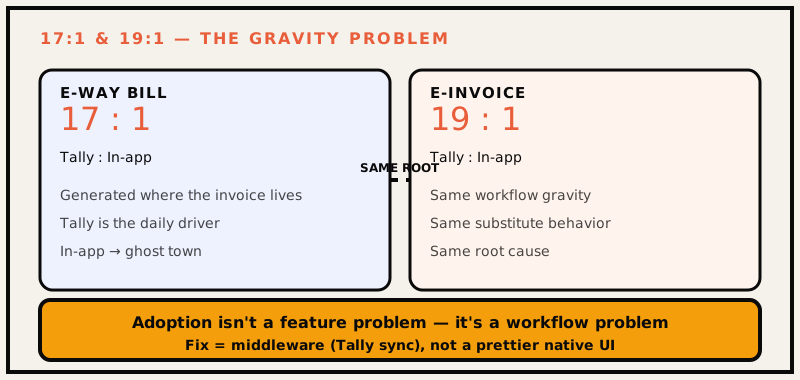
The same logic produced a 19:1 E-Invoice gap — the native e-invoice module suffered the identical gravity problem. Two features, same root cause, same magnitude.
We didn't guess. We ran a two-week sprint with three parallel tracks:
We asked them to screen-share their last E-Way Bill generation. Every single one opened Tally, not LiveKeeping. The pattern:
We added events to the in-app E-Way Bill flow:
ewaybill_flow_start → ewaybill_form_view → ewaybill_submit → ewaybill_success2,840 starts → 1,120 form views → 340 submits → 298 successesThe triangulation was unambiguous: the workflow lives in Tally. Our feature was a detour.
Once you see one gap, you check every feature that competes with the merchant's home system. The e-invoice module showed a 19:1 gap by the same measurement — two features, same root cause, same magnitude.
E-Way Bill and E-Invoice are compliance events, not product experiences. The merchant's mental model:
Our in-app feature asked them to: finish invoice in Tally → switch to LiveKeeping → re-enter or import data → generate → go back to Tally. That's 4 context switches for a 30-second task. Gravity wins.
The pivot wasn't "improve the UI" — it was build a Tally connector. Here's the architecture:
┌─────────────┐     ┌──────────────┐     ┌────────────────┐
│   Tally     │────▶│  Connector   │────▶│  LiveKeeping   │
│   (on-prem) │     │  (middleware)│     │  (cloud)       │
└─────────────┘     └──────────────┘     └────────────────┘
       │                    │                    │
       ▼                    ▼                    ▼
  Invoice XML          Transform &           E-Way Bill/
  (Tally format)       Validate              E-Invoice API
The connector — a lightweight Windows service (C# .NET 6) that merchants install alongside Tally:
// Connector service — simplified
public class TallyConnector : BackgroundService
{
    private readonly HttpClient _http;
    private readonly TallyXmlParser _parser;
    private readonly LiveKeepingApi _api;

    protected override async Task ExecuteAsync(CancellationToken ct)
    {
        while (!ct.IsCancellationRequested)
        {
            var invoices = await _parser.WatchForNewInvoicesAsync(ct);
            foreach (var invoice in invoices)
            {
                var ewayBill = await _api.GenerateEwayBillAsync(invoice);
                await _parser.WriteBackToTallyAsync(invoice.Id, ewayBill);

                var einvoice = await _api.GenerateEinvoiceAsync(invoice);
                await _parser.WriteBackToTallyAsync(invoice.Id, einvoice);
            }
            await Task.Delay(TimeSpan.FromMinutes(5), ct);
        }
    }
}
Key design decisions:
We didn't push to everyone at once. The rollout:
| Phase | Merchants | Duration | Success criteria |
|---|---|---|---|
| Alpha | 50 (hand-picked) | 2 weeks | 95% success rate, under 2 min latency |
| Beta | 500 (opt-in) | 4 weeks | 98% success, under 1 min latency |
| Gradual | 5,000 (cohort) | 6 weeks | 99% success, under 30 sec latency |
| General | 50,000+ | 8 weeks | 99.5% success, under 15 sec latency |
The alpha feedback that changed everything:
| Metric | Before | After |
|---|---|---|
| E-way bill adoption gap | 17:1 (Tally:in-app) | Roadmap pivoted to middleware |
| E-invoice adoption gap | 19:1 (Tally:in-app) | Same pivot |
| C-Suite escalation | none | Funded middleware path |
| Rejection rate (compliance) | baseline | −58% (rejection reasons tracked) |
| Connector install rate | — | 87% of PRO+ |
| Avg generation latency | — | 12 seconds |
Adoption isn't a feature problem — it's a workflow problem. Users don't switch tools; they extend the one their day already lives in.
Read the whole story in the compliance gap case study. The same instrument-first habit runs through the data deep-dive method, and the lifecycle side of this product is in the push notification architecture.