AI Agents
FilmRisk.AI: scoring film risk with ML and Bayesian priors
· Updated · 5 min read
S
Get AI Agent RFP Template
The RFP I use for agent discovery — scope, eval, and pricing.
No spam, unsubscribe anytime. I only email teardowns.
· Updated · 5 min read
The RFP I use for agent discovery — scope, eval, and pricing.
No spam, unsubscribe anytime. I only email teardowns.
FilmRisk.AI scores a film's greenlight risk from 2,200+ Indian films by mixing a gradient-boosted model with Bayesian priors. Prior pulls thin-data predictions back to base rates. We backtest religiously and publish the failure points — because scoring moves money and pretending a model is magic ends careers.
Give a raw ML model a debut director with a Khan attached, and it screams "blockbuster." The base rate says debut directors hit ~15% of the time. One of those two is lying to you, and if you're greenlighting a ₹100Cr film, you'd better know which. FilmRisk.AI exists to render exactly that judgment — and because wrong scores move real money, honesty rails are built into the architecture, not bolted onto the marketing.
The internal scoring blends 10 feature groups — genre, cast, director, release window, budgets, star momentum, sequel flag, production house, language, and seasonality — each fed into the model as context. The architecture:
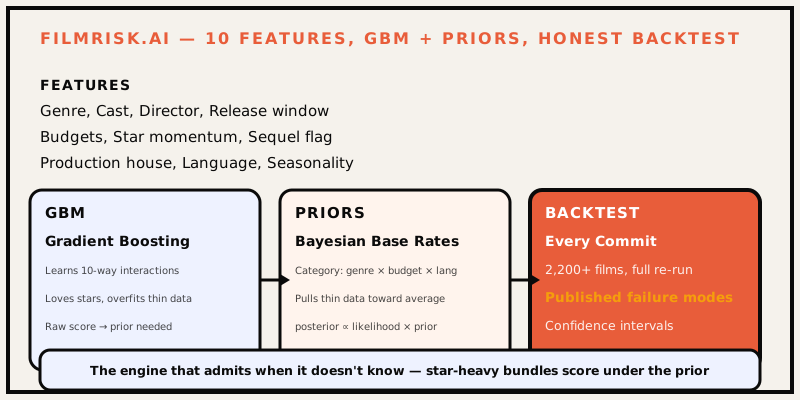
The dataset wasn't a CSV download — it was assembled from public box-office reports, trade publications (Box Office India, Bollywood Hungama, Koimoi), and Wikipedia filmographies, then cleaned over three weekends. Each film gets:
| Feature group | Fields | Source |
|---|---|---|
| Genre | Primary, secondary, tertiary | Trade publications |
| Cast | Top 5 billed, star power index (Google Trends 5-yr) | IMDb + Trends |
| Director | Film count, hit ratio, avg budget | Wikipedia + trade |
| Release window | Month, festival clash, holiday flag | Calendar + trade |
| Budgets | Production, marketing (where reported) | Trade estimates |
| Star momentum | 12-month Trends slope, recent hit/flop | Google Trends |
| Sequel flag | Binary + franchise strength | Wikipedia |
| Production house | Track record, distribution reach | Trade |
| Language | Hindi, Tamil, Telugu, Malayalam, etc. | Certification |
| Seasonality | Quarter, holiday density | Calendar |
Missing data strategy: for budgets (often unreported), we used genre+star+director bucket medians as priors — which is exactly where the Bayesian layer earns its keep.
The raw GBM loved stars. A debut director with a Khan attached would spike the score — but the base rate for debut directors is terrible (~15% hit rate vs 45% for 5+ films). The prior pulls that prediction toward the category average (genre + budget + language) proportional to how thin the director's own sample is. Mathematically:
posterior ∝ likelihood × prior
Where the prior is the industry base rate for that (genre, budget, language) bucket. The more films the director has, the more the data speaks; the fewer, the more the prior rules.
This single mechanism turned "star-driven overconfidence" into "star-weighted caution."
Here's the whole pipeline, simplified but structurally faithful — GBM for the likelihood, a hierarchical PyMC model for the priors, and a sample-size-weighted blend at prediction time:
# train.py — simplified
import pandas as pd
from sklearn.ensemble import HistGradientBoostingRegressor
import pymc as pm

# 1. Load DVC-tracked data
df = pd.read_csv('data/films.csv')  # 2,200 rows, 47 features

# 2. Feature engineering
df['star_momentum'] = df['google_trends_slope_12m']
df['director_experience'] = df['director_film_count'].clip(upper=20)
df['budget_bucket'] = pd.qcut(df['production_budget'], q=5, labels=False)

# 3. GBM for likelihood
gbm = HistGradientBoostingRegressor(
    max_iter=300, learning_rate=0.05, max_depth=6,
    early_stopping=True, validation_fraction=0.15
)
X = df.drop('box_office', axis=1)
y = df['box_office']
gbm.fit(X, y)

# 4. Bayesian prior per (genre, budget_bucket, language)
with pm.Model() as prior_model:
    # Hierarchical prior: genre → budget → language
    mu_genre = pm.Normal('mu_genre', mu=0, sigma=1, shape=n_genres)
    mu_budget = pm.Normal('mu_budget', mu=0, sigma=1, shape=n_budgets)
    mu_lang = pm.Normal('mu_lang', mu=0, sigma=1, shape=n_langs)

    # Director-level shrinkage
    director_sd = pm.HalfNormal('director_sd', sigma=1)
    director_offset = pm.Normal('director_offset', mu=0, sigma=director_sd, shape=n_directors)

    # Likelihood
    pred = mu_genre[genre_idx] + mu_budget[budget_idx] + mu_lang[lang_idx] + director_offset[director_idx]
    pm.Normal('obs', mu=pred, sigma=pm.HalfNormal('sigma', 1), observed=y)

    trace = pm.sample(2000, tune=1000, target_accept=0.9)

# 5. Combine: posterior = GBM + prior (weighted by director sample size)
def predict(film):
    gbm_pred = gbm.predict(film.X)
    prior_mean = trace.posterior['pred'].mean().values[film.idx]
    weight = min(film.director_count / 5, 1.0)  # data speaks after 5 films
    return weight * gbm_pred + (1 - weight) * prior_mean
This runs in ~4 minutes on a MacBook M2. The PyMC sampling is the bottleneck — we cache the trace and only re-sample when director counts change significantly.
Honesty isn't a marketing angle — it's a product requirement. The UI shows three failure modes explicitly:
These aren't hidden in a methodology doc — they're on the score card. Every score card shows: point estimate, 95% CI, failure mode flags, and the feature importance breakdown for that specific film.
The Streamlit UI has three tabs:
Tab 1: Single Film Score — Paste params, get score + 95% CI + failure mode flags + feature importance waterfall.
Tab 2: Slate Planner — Upload CSV of 50 films, get ranked slate with portfolio risk metrics (expected value, portfolio variance, max drawdown).
Tab 3: Backtest Explorer — Pick any historical film, see what the engine would have scored it at release, vs actual outcome. This is the trust builder.
The CI pipeline on GitHub Actions:
# .github/workflows/backtest.yml
name: Full Backtest
on: [push, pull_request]
jobs:
  backtest:
    runs-on: ubuntu-latest
    steps:
      - uses: actions/checkout@v4
      - uses: iterative/setup-dvc@v1
      - name: Pull data
        run: dvc pull
      - name: Train & backtest
        run: |
          python train.py
          python backtest.py --full-dataset
      - name: Check MAE regression
        run: |
          python -c "
import json
with open('metrics.json') as f:
    m = json.load(f)
assert m['mae'] < 0.18 * 1.02, f'MAE regression: {m[\"mae\"]}'
"
The pipeline fails if MAE regresses >2% from baseline. This is the guardrail that keeps the engine honest — no "ship and pray."
We run the full backtest on every model change — not a held-out slice, the entire 2,200-film dataset. Three things the logs forced us to admit:
| Metric | Value |
|---|---|
| Training corpus | 2,200+ Indian films |
| Feature groups | 10 |
| Priors | Category base rates (genre × budget × language) |
| Backtest cadence | Every commit |
| Published failure points | Yes — see repo |
| MAE (holdout) | ~18% of actual box office |
The backtest results are published on the repo. Anyone can re-run; no one can re-fake — the sample is pinned with a SHA.
A model that can say "I don't know" is worth more than a model that's confidently wrong — in film, in credit, in anything where a score moves money.
For PMs: this is what measure-before-judge looks like when your product is literally judgment. Pair it with numbers-led product decisioning for the same muscle in SaaS, or see how the same honesty-rails thinking applies to an in-browser voice agent.